Everyone Has The Tool
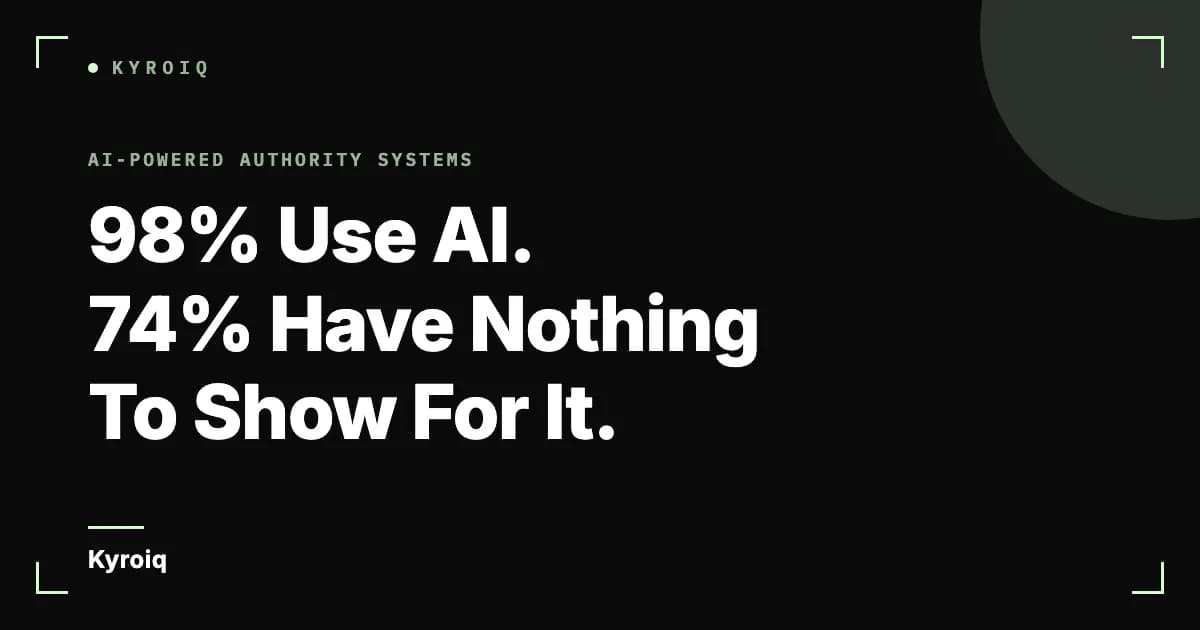
98% of thought leadership teams already use AI. 74% still have nothing to show for it. That is the actual finding buried inside iResearch Services' second annual benchmark study of 1,000 professionals, and it is a more useful number than the adoption statistic most coverage of AI in marketing has been repeating for two years.
Adoption was never the question
For most of the AI content conversation so far, the implicit question has been whether teams would adopt AI tools at all. That question is now effectively settled. Only 2% of teams surveyed avoid AI entirely in their thought leadership work, which means the debate over adoption is over in every practical sense. Almost every team has the tool.
What the benchmark study makes clear is that adoption was never actually the hard part, and treating it as the finish line was a mistake most of the industry made at the same time. Close to three quarters of teams using AI are not running their thought leadership program strategically, despite having the same underlying technology as the teams that are. The tool being present in an organization says almost nothing about whether it is being used well.
Where the 74% actually breaks down
The benchmark study points to a specific, structural gap rather than a vague execution problem. Close to a third of the surveyed teams have no formal governance policy for how AI gets used in their content process at all: no standard for what gets fact-checked, no defined role for who verifies a claim before it publishes, no consistent editorial judgment applied across everything the tool touches. AI, in those organizations, is being used the way a word processor is used: as a tool anyone on the team reaches for individually, with no shared standard for what "good" looks like once it reaches an audience.
That absence of governance is not a minor operational gap. It is the entire difference between an organization that has a tool and an organization that has a system. A tool used inconsistently produces inconsistent output: some pieces well-researched and specific, others thin and generic, with no reliable way for an audience to know in advance which kind they are about to read. Inconsistency, at scale, reads as unreliability, and unreliability is exactly what erodes the trust a thought leadership program was supposed to be building in the first place.
The system is the part nobody built
Everyone already has the tool. Almost nobody has the system around it, and that gap is the whole premise a content operation should be built around solving. A system, in the sense that matters here, means AI drafts content inside a defined process: editorial standards applied consistently, a sourcing discipline that checks claims before they publish, and a real verification step that catches what a draft got wrong or overstated before an audience ever sees it. Nothing ships until it clears that bar, regardless of who on the team happened to prompt the draft.
The tool was never supposed to replace the judgment behind a piece of content. It was supposed to move that judgment faster, letting a real point of view reach an audience at a pace no person writing entirely by hand could sustain. A team with the tool but no system inverts that relationship. The tool moves fast. The judgment either lags behind it or is never applied consistently at all, which is precisely the pattern the 74% figure is describing at scale.
Building the system before selling it
We built that system before applying it commercially, testing it on two independent ventures started from zero, with no existing audience and no paid promotion. Two months in, what produced measurable results was not a faster model. It was consistent sourcing discipline and a real editorial standard applied to every piece before it published, producing more than 4,000 followers combined and inbound opportunities neither venture went looking for.
Nothing about that result depended on access to a better AI tool than anyone else could get. The tools involved were broadly available to any team willing to use them. What was not broadly available, and what the benchmark study suggests almost three quarters of teams are still missing, was the governance structure that turns a fast tool into a reliable one.
The differentiator was never the tool
The benchmark study's real finding is not that AI adoption in thought leadership has plateaued at some meaningful level below full saturation. It is that adoption reached near-total saturation months or years ago, and it made almost no measurable difference on its own. The tool was never the differentiator between the teams producing results and the teams producing volume. The system running it is, and building that system is the work that adoption alone was never going to do automatically.
There is a specific risk in reading the 98% adoption figure as reassuring, and it is worth naming directly. A team can point to near-universal AI adoption inside its industry and conclude it has already kept pace with the shift, when adoption was never the part of the shift that mattered. The benchmark study's real message to any team using that figure as reassurance is that being part of the 98% says nothing about which side of the 74% gap that team is actually on. The governance policy, the verification step, and the editorial standard applied before anything ships are the only parts of this that were ever going to separate the two groups, and none of those show up in an adoption statistic.