The Trust Gap: What APQC's Executive Survey Means for AI-Written Thought Leadership
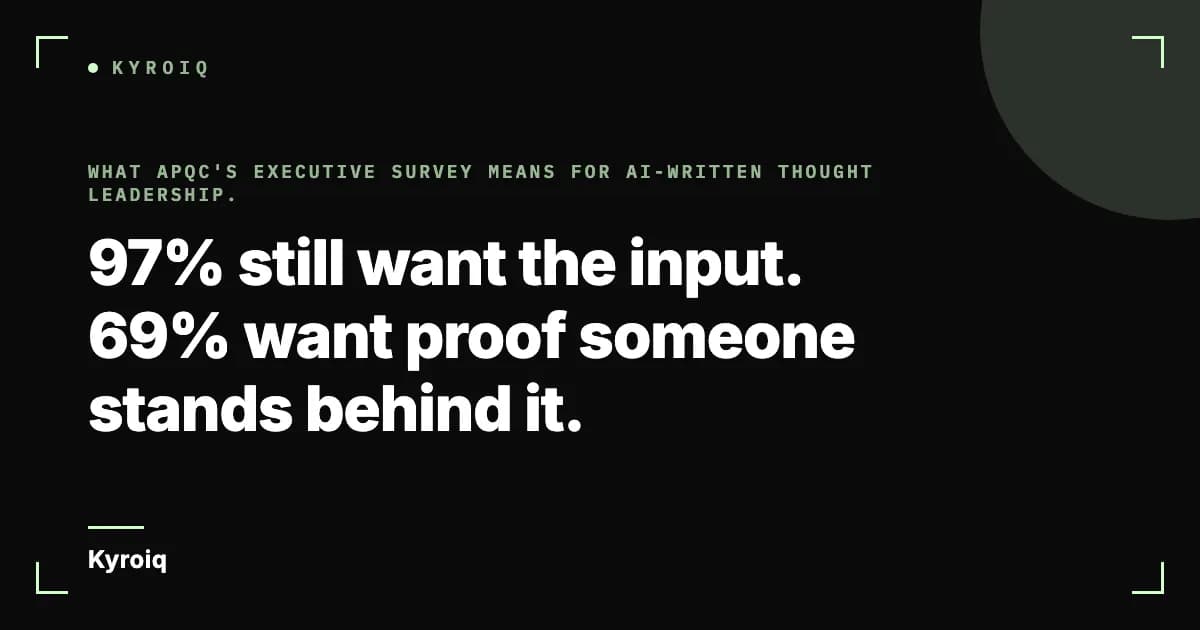
APQC's Global Thought Leadership Institute surveyed 1,000 C-suite executives and 359 thought leadership producers this year, and the two numbers that came back sit in direct tension with each other. Ninety-seven percent of executives say thought leadership shapes the decisions they make. Sixty-nine percent say their willingness to keep reading it drops the moment they sense the organization behind it used AI without anyone standing behind the result. The audience never left. It got more selective about who it trusts to have actually done the thinking.
Why the gap matters more than either number alone
Read in isolation, 97% looks like validation and 69% looks like a warning about AI. Read together, they describe something more specific: executives are not evaluating thought leadership on format anymore, they are evaluating it on provenance. The same executive who relies on a well-argued piece to shape a real decision is also the one most likely to notice when that argument was assembled rather than authored, because the stakes of getting the decision wrong are the reason they read the piece in the first place.
That combination explains why the volume strategy so many organizations adopted over the past two years is now working against them. Publishing more, faster, on every AI-enabled channel available, looked like a way to close the visibility gap with larger competitors. APQC's numbers suggest it opened a different gap instead, between how much content an organization produces and how much of it its own target audience is still willing to read.
APQC surveyed 359 thought leadership producers alongside the 1,000 executives, which is itself worth noting. This is not a single research team's read on the market from the outside. It is a direct comparison between what the people producing thought leadership are doing and what the people consuming it are actually willing to tolerate, gathered from both sides of the same exchange in the same study.
What breaks trust is not the tool
It is worth being precise about what the 69% figure is actually measuring, because the easy misreading is that executives have turned against AI-assisted writing as a category. That is not what the data shows. What erodes trust is the absence of anyone verifiable standing behind the output, not the presence of a tool in the drafting process. A piece that used AI to move faster and was then checked, sharpened, and stood behind by someone with real judgment reads no differently than one written by hand. A piece with no verification step reads as exactly what it is, regardless of how it was produced.
That distinction is the entire premise behind the Kyroiq Authority Method: AI drafts inside a system built around it, and a real point of view verifies everything before it ships. We proved the mechanism before this survey gave it a name. Two independent ventures, started from zero with no existing audience, reached 4,000-plus followers in two months without a dollar of paid spend, because what got published had a real perspective behind it, not because it was produced quickly.
What earns the right to keep publishing
The organizations still trusted after this shift are not the ones that publish least, and they are not the ones that avoid AI. They are the ones whose output survives the question every skeptical executive is now silently asking: did a real person with real judgment stand behind this before it went out. That question was always implicit in thought leadership. AI-generated volume simply made it explicit, because it created the first large-scale test of what happens when publishing speed outpaces the verification that used to be assumed.
Answering it requires a system, not a policy. A one-line disclaimer about AI use does not rebuild trust, and neither does simply slowing down output across the board. What rebuilds it is a repeatable process where every piece is checked against a real perspective and a real standard before it ships, so the 69% who pull back at the first sign of unverified AI content never encounter the organization's work in that state at all.
What this means for founders and growing organizations
Smaller organizations without an established reputation face the sharper version of this problem. A recognized brand can absorb a few pieces of thin, obviously AI-assembled content without losing all of the trust it built over years. A founder or growing company publishing thought leadership for the first time has no such buffer. The first few pieces an unfamiliar executive reads from a new voice are doing double duty, making the argument and establishing whether that voice is worth continuing to read at all. Getting the verification step wrong at that stage costs more than a single missed post.
The organizations treating this as urgent right now are not the ones already established as trusted voices. They are the ones deciding, this quarter, whether their content operation has an actual verification step or just a publishing calendar. That decision compounds. Every piece published without it makes the next piece from that source easier to dismiss.
The mechanism, not the moment
APQC measured a real shift in how executives evaluate thought leadership, not a temporary reaction to a news cycle about AI. The number worth remembering is not 97% or 69% individually. It is the relationship between them: the audience still wants the input, and it is actively sorting for the sources that verified what they published before it reached them. The organizations building that verification into their process now are the ones the 97% will still be reading once the rest of the market catches up to what changed.